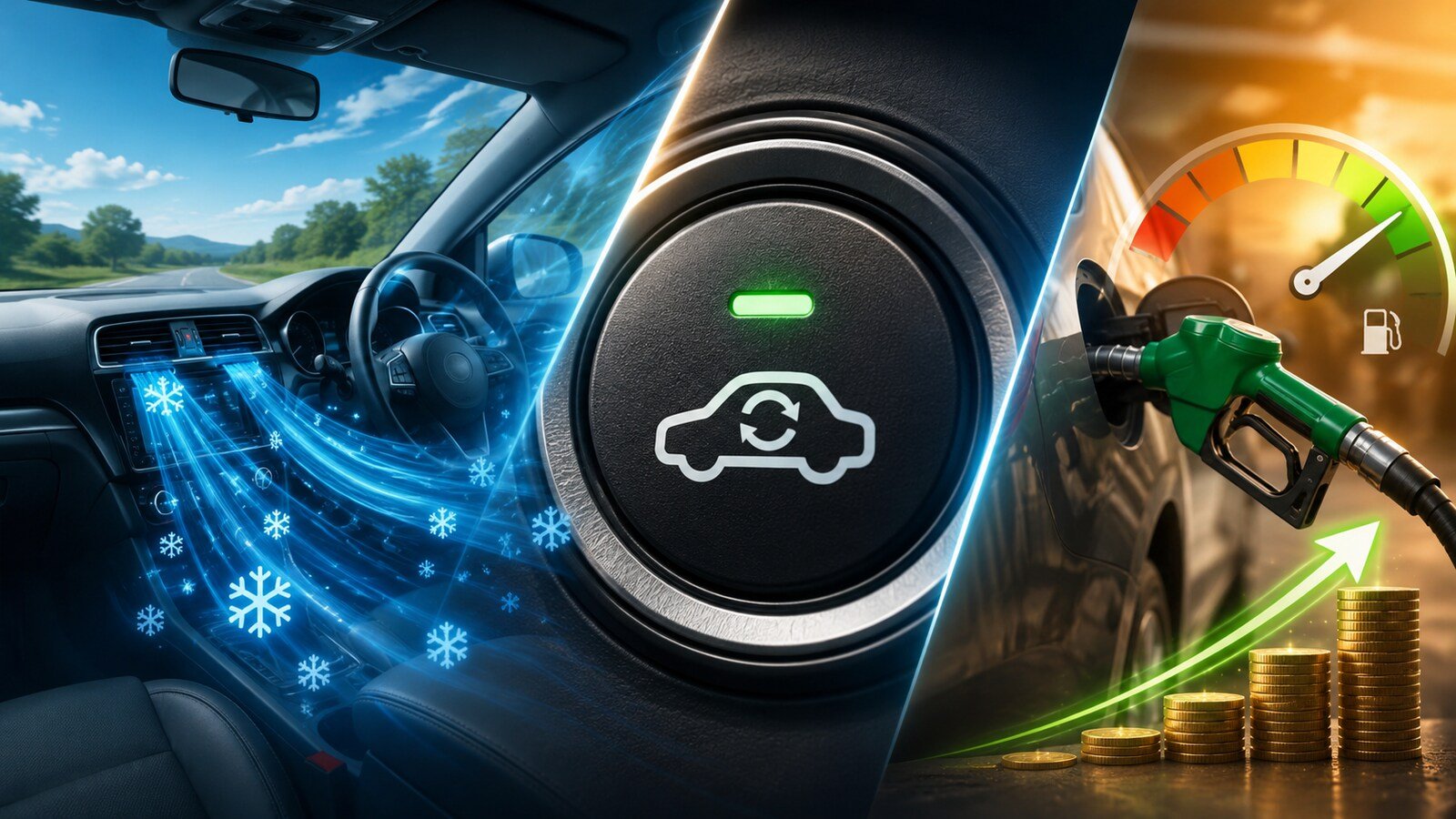
A colleague once told me he switches off his AC on flyovers to “save fuel,” which honestly doesn’t make much sense mechanically. But he wasn’t entirely wrong in spirit — your AC genuinely does affect mileage, just not in the way most people assume. These car AC fuel consumption tips focus on what actually helps, based on how the system really works.
Let’s clear up some myths and get into what genuinely reduces fuel usage.
How Much Fuel Does Running the AC Actually Cost You
Direct answer: running your car AC typically increases fuel consumption by 5-10% in city driving conditions, mainly because the compressor draws power directly from the engine, especially noticeable at lower speeds and in stop-start traffic.
The impact is proportionally smaller at highway speeds since the engine’s already working harder overall, and rolling down windows at high speed actually creates more aerodynamic drag than running the AC does. So contrary to popular belief, AC on with windows up is usually more fuel-efficient above 60-70 km/h.
Don’t Turn the AC On Immediately After Starting the Car
A car parked in the sun for hours has scorching hot air trapped inside. Running the AC immediately forces the compressor to work at maximum capacity right away, which pulls more power from the engine.
- Roll down the windows for 30-60 seconds first to let hot air escape
- Start the AC on a lower fan setting initially
- Gradually increase fan speed as the cabin cools
This single habit alone reduces the initial fuel spike noticeably, especially in summer.
Keep the AC System Well Maintained
A poorly maintained AC — dirty filters, low refrigerant, clogged condenser — makes the compressor work harder to achieve the same cooling, which directly translates to higher fuel consumption. [link to related guide about car AC maintenance tips here]
Getting your AC serviced regularly isn’t just about comfort; it genuinely affects your fuel bill over time.
Use Recirculation Mode Wisely
Recirculation mode cools the cabin faster since it’s cooling already-cooled air rather than pulling in hot outside air constantly. This means the compressor doesn’t have to work as hard once the cabin reaches your desired temperature.
- Use recirculation for the first 5-10 minutes to cool down quickly
- Switch to fresh air mode occasionally to avoid stale, stuffy air buildup
- Avoid pure recirculation for very long drives — it can increase CO2 levels inside the cabin over extended periods
Park in Shade to Reduce Initial Cooling Load
This one’s obvious but genuinely underrated. A car parked in direct sun for a few hours can have a cabin temperature well above 50-55°C. Cooling that down from scratch demands significantly more compressor effort — and fuel — than cooling a car that was parked in shade.
Use a windshield sun shade if shaded parking isn’t available; it noticeably reduces how hot the cabin gets.
Set a Reasonable Temperature, Not the Coldest Setting
Cranking the AC to the absolute coldest setting doesn’t cool the car faster — it just makes the compressor run at maximum load for longer. A moderate setting around 22-24°C, combined with a reasonable fan speed, cools effectively without unnecessarily straining the system.
Don’t Ignore Tyre Pressure — It Affects Overall Mileage Too
This isn’t directly AC-related, but under-inflated tyres increase rolling resistance and reduce overall mileage, which compounds with AC-related fuel usage. Check tyre pressure monthly; it’s a five-minute task that pays off continuously.
Avoid Excessive Idling With AC Running
Sitting in traffic or waiting somewhere with the engine idling and AC on burns fuel for essentially zero distance covered. If you’re going to be stationary for more than a couple of minutes, consider switching off the engine if it’s safe and practical to do so.
Windows Up vs Down: When Each Makes Sense
Has this ever happened to you — someone insists rolling windows down “saves gas” regardless of speed? It’s more nuanced than that:
- Below 50-60 km/h: windows down is often marginally more fuel-efficient than AC
- Above 60-70 km/h: AC with windows up tends to be more efficient due to aerodynamic drag from open windows
- In heavy traffic or dusty conditions: AC is usually the more practical choice regardless of the small fuel difference
FAQs
Q1. Does running the car AC really reduce mileage significantly? Yes, typically by 5-10% in city driving, mainly because the compressor draws power from the engine. The effect is smaller at highway speeds.
Q2. Is it better to drive with windows down instead of using AC to save fuel? At lower speeds, yes, marginally. At highway speeds, AC with windows up is usually more efficient due to aerodynamic drag from open windows.
Q3. Does AC maintenance actually affect fuel consumption? Yes, a poorly maintained AC system with a dirty filter or low refrigerant makes the compressor work harder, which increases fuel usage for the same cooling output.
Q4. Should I turn off the AC while idling in traffic? Not necessarily just for the AC’s sake, but if you’re stationary for an extended period, switching off the engine entirely (if safe to do so) saves more fuel than adjusting the AC alone.
Q5. Does setting the AC to the coldest temperature cool the car faster? No, it just makes the compressor work at maximum load for longer without meaningfully speeding up the cooling process. A moderate setting is usually just as effective.
Q6. Does recirculation mode save fuel compared to fresh air mode? Generally yes, since it cools already-cooled air rather than constantly pulling in hot outside air, reducing compressor workload once the cabin has cooled down.
Conclusion
Your AC doesn’t have to be a fuel-guzzling trade-off if you use it sensibly — crack the windows before switching it on, keep the system maintained, and avoid unnecessarily cold settings that don’t actually cool faster. Small habits add up over a month of daily driving.
Try adjusting just one or two of these habits on your next few drives and keep an eye on your fuel gauge over the following week — the difference is usually more noticeable than people expect.
Suggested image alt text:
- “Driver adjusting car AC temperature settings on dashboard”
- “Car windows rolled down briefly before turning on AC in hot weather”
- “Fuel gauge display showing mileage in a car dashboard”